
Member-driven communication and innovation
At the core of The Union's mission is a connected community bound by a shared vision for tuberculosis elimination and improved lung health. Over the past 18 months, member feedback has consistently requested clearer engagement pathways and modern communication structures. In response, the Board of Directors and senior management team have implemented several changes to our structures and procedures. We have also revised the governance and engagement framework. This framework describes:
- Relations among members, the Board and staff
- The establishment of eight specialised committees
- New opportunities and pathways to turn grassroots member ideas into high-impact global outcomes
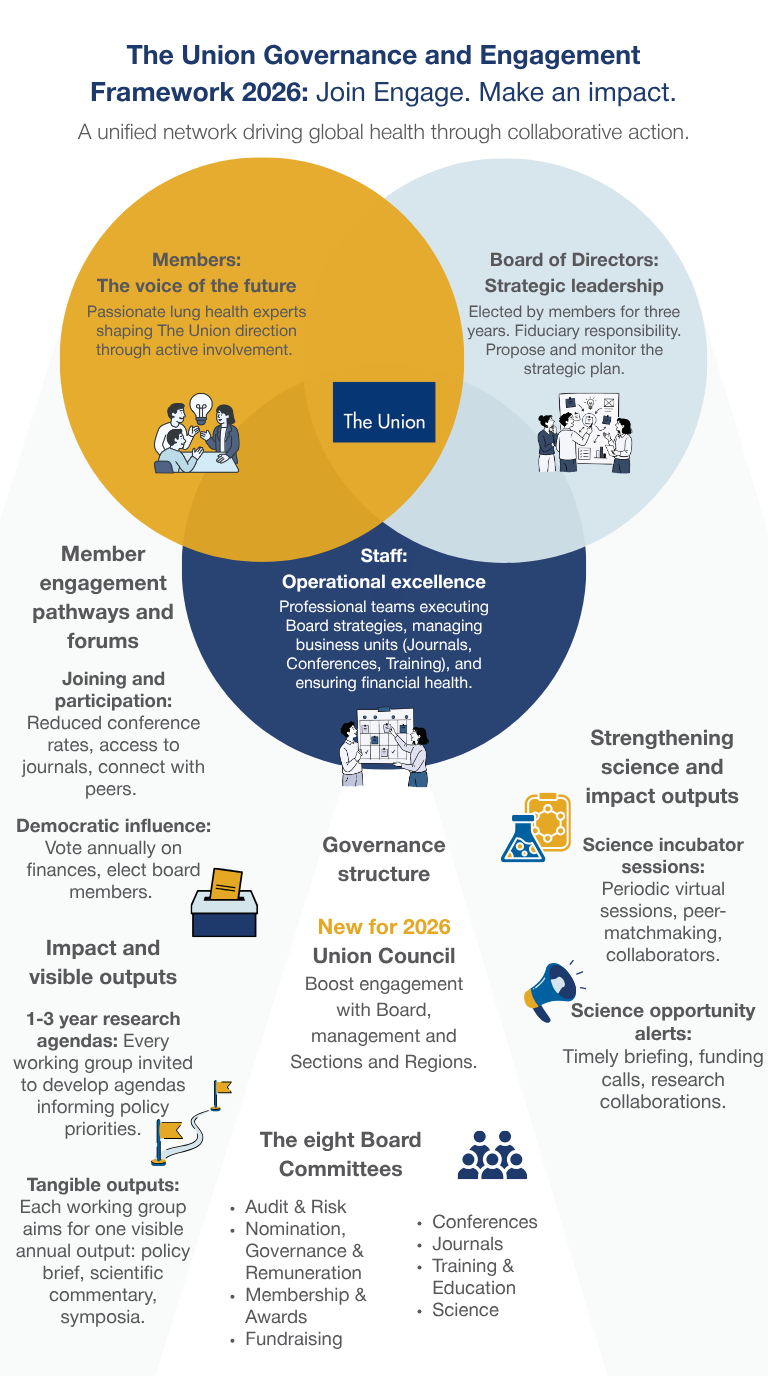
At its core: An interdependent collaboration model
The Union's collaborative framework relies on an interdependent partnership between three central groups: its global membership (both organisations and individuals), the governing Board of Directors, and the professional staff. This relationship ensures that strategies developed by representative leadership are effectively implemented on an operational level, while remaining deeply rooted in member engagement.
|
Pillar |
Constitutional mandate and authority |
Core contributions and activities |
|
Members |
Become a member, pay annual membership dues, and exercise primary control over the organisation through the General Assembly. |
|
|
Board of Directors |
Directors are elected from the membership by the members at the General Assembly for three years. The Board has fiduciary responsibility for the organisation. |
|
|
Staff |
Led by Executive Director to oversee day-to-day operations and deliver core services. |
|
Modernised governance: Board committees
The Board established eight committees designed to provide strategic direction, and in some cases operational support, on priority topics. These committees operate under authority delegated by the Board. They report to the Board to recommend actions (resolutions) to be taken within their portfolio. In some instances, the Board has delegated authority to make decisions that do not need to be taken by the Board.
The Board committees
- Audit and risk: Provides financial oversight, risk evaluation, and safeguards organizational compliance and transparency.
- Nomination, governance & remuneration: Maintains board selection integrity, reviews constitutional alignment, and establishes compensation/recognition structures.
- Membership and awards: Drives membership recruitment, enhances member retention, and administers official awards and recognition program.
- Fundraising: Maps global donor landscapes, explores philanthropic opportunities, and guides organizational financial sustainability.
- Conference: Shapes the overarching clinical and scientific theme, tracks, and programmatic layout of the World Conference.
- Journals: Oversees the strategic expansion and development of the International Journal of Tuberculosis and Lung Disease (IJTLD) and related publications.
- Training and education: Oversees development, content updates, and delivery of professional courses, webinars, and educational publications.
- Science and policy: Acts as the central coordination hub for scientific initiatives, grant-seeking strategies, policy development, and advocacy campaigns.
The balanced representation model
To bridge communication gaps and integrate diverse perspectives, each committee adopts a balanced composition model. The committees bring together:
• 1 to 3 Board Members (one of whom acts as Chair, who reports to the Board)
• 1 to 3 other Members of The Union.
• 1 to 3 Staff members who have responsibilities directly aligned with the committee's scope of work.
In most cases the non-Board members of the Committees are selected through an open transparent Expression of Interest process. In some instance, where highly specific skills are required (such as legal and finance) the Board or the Committee seeks out suitable individuals.
Translating membership activity into output
In late 2025, The Union launched email groups across all regional networks and began publishing calendars of events and official Board meeting summaries. To build on this momentum, the framework avoids creating heavy administrative layers. Instead, it elevates and enables the Sections, Sub-Sections, Regions and Working Groups by connecting them directly to their members. Creating opportunities for scientific collaboration and tangible year-round outputs.
Key scientific engagement mechanisms
Union science incubator sessions
Periodic virtual sessions where members present early-stage clinical research, implementation science concepts, or grant ideas. This serves as a peer-matchmaking and networking platform across the membership base to secure potential collaborators and build strong research alliances.
Union science opportunity alerts
A periodic briefing compiled and distributed to members, highlighting upcoming fellowship opportunities, research collaborations, and relevant global funding calls in tuberculosis and lung health.
Expressions of Interest (EOI) for grant opportunities
For major international funding calls (e.g. Unitaid, EDCTP, the Gates Foundation, Wellcome Trust, Horizon Europe, or USG funding mechanisms), The Union will circulate EOIs to members. This identifies country presence, localised infrastructure, and specialised technical capabilities, allowing members to develop and participate in major bids actively.
Working group research agendas
Working groups are invited to develop a rolling 1-to-3-year research agenda outlining evidence gaps, policy priorities, and critical research questions. This document directly shapes Union advocacy priorities and Union World Conference on Lung Health scientific programme.
Clear annual outputs
Rather than limiting activity to conference attendance, each Section, Sub-Section, Region and Working Group is structured with the operational goal of producing at least one visible annual output. This includes translating member expertise into peer-reviewed policy briefs, scientific commentaries, consensus statements, or dedicated conference symposia.
Established the Union Council
A new forum aiming to increase member engagement with the Board of Directors and Union management. The council is made up of scientific section, subsection, and region representatives.
Conclusion and action roadmap
The Union Governance and Engagement Framework is both strategic and operational, using modern tools to enable members to participate at all levels of The Union. By integrating balanced member representation into Board committees and launching peer-driven research tools, like science incubator sessions, The Union transitions from a conference-centric network to a year-round engine of collaborative impact. Members are encouraged to actively engage by participating in upcoming EOI calls, submitting editorial content, and joining local section communications.